
A Not So Secret Third Thing
I hope you... realize... what it is

Mr. Saunders says I am wrong.
First, I must caution him, there are a lot of Brian Moores out there, you gotta make sure you’ve got the right one. Thankfully, he’s on target here. (I would include J.K. Lundblad as a target, as I was defending the honor of his valiant and correct criticism of wealth taxes)
Second, the background of this debate:
It grew out of a side exchange1 we had over the canard that “you can’t tax unrealized capital gains”. TL;DR: average Americans are already taxed annually on the unrealized gains on their main asset, their homes.
I cited my post to him as my argument for why I thought the “realized vs unrealized” distinction matters so much to people, both in the context of “taxing assets” AND “what does it mean to be rich.” Specifically: that the way people use the concept “rich” (both today and historically) implicitly reveals that they really do morally differentiate between the treatment of realized and unrealized wealth. Yes, on an academic level, re-assessment of property taxes is a form of unrealized gains taxation.
My point is, instead, that the massive number of caveats/limitations on property taxes (infrequency of reassessment - often only at point of realization, deliberate undervaluing, exceptions for people with static incomes, relatively limited extent of property taxes on total net worth for most) indicate a strong dislike of that form of taxation. Similarly, yes, obviously you can physically pass a law to tax unrealized capital gains, just like you can physically set income taxes to 99%. In normal political conversation we use the phrase “can’t” to imply “if you do this, voters will revolt and undo what you did.”
Third, and this will be the theme of everything else, I think the question of “Is Mr. Saunders right that I am wrong?” is essentially immaterial, because I think he misses my point (right or wrong) entirely. I am not going to try to argue that he is wrong, I will argue that we share the same goals, and that we can both achieve them simply by reconciling certain concepts.
Some examples:
Brian’s main thesis seems to be about the moral valences/judgments applied to the Super Haves. That some are good (what he calls the “producers”) and some are bad (the “consumers“). Warren Buffett as archetype of the former, given his famously frugal lifestyle, even as the 10th richest person in the world.
This seems like a bizarre starting point for someone who’s entire idea system is based on Liberty. What difference does it make how someone disposes of their wealth??
Because I’m not talking about liberty? Liberty is a different debate, in a different context. In the context of efficient economic policy, it absolutely does matter: if someone saves/invests 10 bucks (resulting in there being more stuff next year) then it is very different than if someone consumes 10 bucks worth of stuff this year, resulting in there being less stuff for the rest of us, all else equal. They’ve even got different letters for them in first year economics equations. If you treat them as having no difference you will not have a good economy, or much in your retirement fund.
The economy is powered by consumption. It needs savings. It needs investment. All three.
And no one is saying we should abolish either. I say “either” instead of “any of the three” because savings and investment are the same thing in this context. The question always is on the margin, which should we incentivize more, for optimal outcomes? And every econ textbook knows that if you want to have more stuff next year, you want to incentivize investment over consumption, because consumption involves consuming stuff and investment involves making more stuff. This isn’t even economics, this is… reality. Obviously, no one would recommend consuming nothing, or reducing consumption to levels where one suffered harms from it. This is like someone saying “I think I should go on a diet and eat less food” and you replying “that’s a ridiculous plan, you need food to live!” Think on the margin.
There’s no compelling data supporting the idea that ever stretched skew of the distribution curve is necessary for overall growth of the economy and shared progress and prosperity.
Again, this is not what I am saying. I am saying that savings/investment are necessary for increased future growth and prosperity, on the margin. Therefore, as “possession of unrealized assets” are the mechanism by which investment occurs, we should endeavor to have more of it. “Unrealized” is the key idea, not only to “taxes” or “rich” or whatever, but at a deep level of the literal concept of what it means to have something. “Unrealized” means that I actually do not have the wealth, it has been shared with someone else, I have deferred the consumption of real goods. This is the core understanding of so much more than economics.
This is extremely vital to understand: when I buy 10 shares of Apple stock I have nothing - I possess only a unrealized concept of subjective value. The person who sold me the stock, and then bought a yacht worth [10 x AAPL] - he has the wealth. The wealth is the yacht. Unrealized assets cannot be material wealth because without that distinction, there would be no reason for the word “unrealized” to exist. This is the conceptual fabric of human language. Don’t mess with it.
Yes, obviously I am well aware that in colloquial usage, we do refer to people who hold lots of unrealized assets as “rich” or “wealthy,” but it is always and everywhere predicated on the implicit assumption (and the extent to which) that paper wealth can be realized into real goods. If I own ten million shares of Apple, today I am rich. If tomorrow Apple stock goes to zero, I am no longer rich. That this is exactly how people use the word reveals to us that the obvious semantic payload of “rich” or “wealthy” implies realization, or at least the capability thereof.
So in regular day to day usage, where we normally expect that most paper wealth will indeed be realized in the course of action, we can use the terms interchangeably, safe in our assumption that there will be a lot of overlap between the people who are paper-rich and who are goods-rich. But the problem is that in this conversation, the phrase “we should tax unrealized gains” violates that gentleman’s understanding of the term, because “tax” is heavily contingent on “realized or not.”
And, to bring it all back around to the top, it means that no, you actually cannot tax people’s unrealized assets, that is conceptually invalid. If congress passed a law saying “10% unrealized assets tax” what actually would (ignoring the protests and revolts and guillotines) happen is that I would need to pay US dollars in taxes in relation to 10% of what it says on my Vanguard dashboard on April 15th - let’s say that’s $1,000. In order to do this, I have to sell $100 worth of my portfolio (using on-hand cash is equivalent, remember fungibility), which means giving other people (let’s say Bob) those stocks in exchange for money.
Now, this is the important part, where I truly channel Scott Sumner : the true change, the true meaning of “who is taxed” is “who consumes less of what was produced this year?” Before the wealth tax law, Bob was going to consume that hundred bucks to buy a yacht. He would therefore have had a yacht, he’d be yacht-rich. But now, with the tax, instead he defers that consumption, and holds $100 (actually probably less than $100, because the price drops from everyone selling it to pay their taxes) in stocks. Now he’s yacht-poor. Instead, the government takes the money and buys a yacht (the only thing this toy economy produces is yachts) for Kash Patel to go to hockey games. The true accounting of the tax is thus:
Bob: minus one yacht
Kash Patel: plus one yacht

Guess who’s not on this list? Me! I wasn’t actually taxed because not one single real thing was taken away from me. Because the person who bears the cost of a tax is the person who has less of the thing after, and since the thing being taxed (unrealized assets) was a thing I had given to Bob, he is the one who bears the objective reality burden. I’m against unrealized gains taxes on me, because they take from Bob! The mechanical process of “unrealized gains taxes” is exactly “taking out of the national investment column” and putting it into the “consumption” column1. That’s not my insane libertarian interpretation, that is simple reality.
In terms of real resources - the context that matters - this tax is a redistribution from Bob to whoever receives whatever the government buys with the tax revenue. The “unrealized” context is…. well… it’s not real. It’s right there in the name!
You may have heard a variant of this tax incidence question in the tariffs debate, and it works the same way. Importers pay tariffs nominally, but if they can pass on equivalent price increases to their customers, in a real, meaningful way the customers have “paid” the tax (i.e. they now can consume less) even though they didn’t interact with the government at all. These are just facts: American consumers pay tariffs, and taxes on unrealized assets are paid by Bob, or whoever consumes less as a result of it.
Mr. Saunders claims I am “defending the rich” from taxation, let the above stand as evidence that I am actually defending Bob, whether or not he is rich.
Okay, back to the rebuttal:
Brian starts off with a historical howler, arguing that in antiquity, being rich was only about consumption. I guess he’s never heard about Julius Caesar’s will, gifting three months wages’ equivalent to all 320,000 male citizens of Rome … in coin.
Again, missing the point. I challenge you, the reader, to re-read the claims I made and ask themselves if the point I was making was one that would be refuted by “one time a guy gave some other people currency”? Obviously the claim was not “no one ever used currency,” it was that people’s perception of what they meant when they said “rich” always meant “realized material wealth.” Caesar is one of the worst examples for this case! Notoriously in debt - what is debt but the realization of other people’s money? - and who “earned” lots of that money by plunder, and who is known throughout history for purchasing the loyalty and votes of his countrymen with lavish displays of material wealth. Caesar was all about realizing assets, that is what he was known for, he bought the Roman Empire with strategic realization of assets and demonstration of wealth in precisely the manner his countrymen expected, as an embodiment of a rich and powerful citizen!
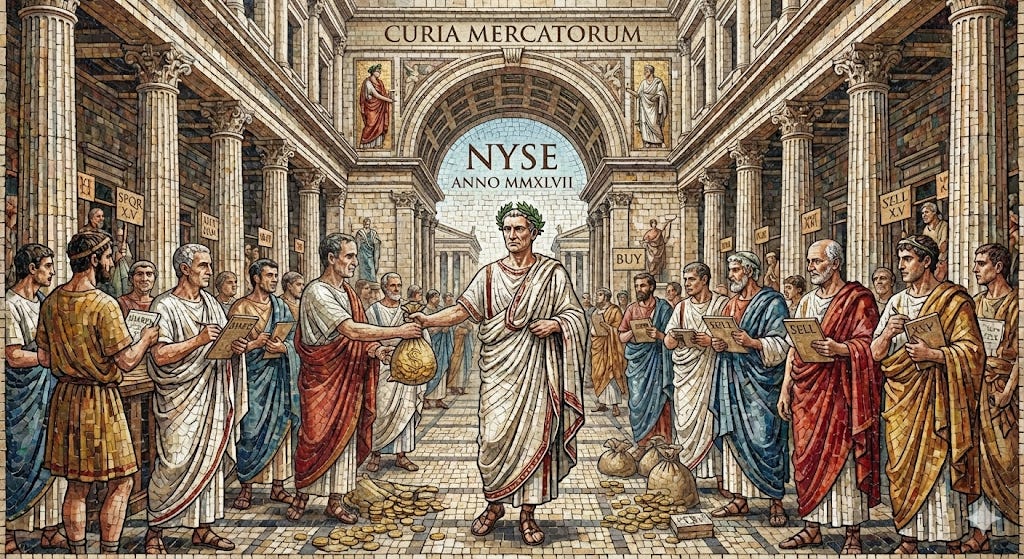
This is my case: if, throughout his career, Caesar had only acquired promissory notes to Gallic estates (freely given, surely), and never spent them, or cashed them out for gifts for his soldiers, or rewards for followers, or bribes, he would not be famous, he would not have been powerful and no contemporary would have called him rich or powerful. In fact, to the current debate, whatever Roman taxes existed that rich people would have to pay, he would have (if he only owned notes) been exempt from them, because they were all levied on real material assets.
Onward, in rebuttal to my idea that Ancient Roman Warren Buffett would not have been considered “rich”2 back then, because all he had were greenbacks:
Buffett’s wealth is not in green papyrus. It’s in bits in a vast array of digital ledgers, all secured ultimately by the power of the US Department of Defense which backs up the power of the US-dominated global financial system
This seems pedantic? It’s obviously just contingent promises? If the value of his stock goes to zero, the DoD will not be securing anything, because it’s gone. And no one - Romans or today - would call him rich. Again, maybe I’m just being unclear - my apologies.
Buffett could trivially fly in on a private airplane (rented NetJets is his preference these days) that would dazzle those ancients to the point of thinking he’s a deity from the sky.
Renting a jet is consumption, a realization! The entire point is that if you buzzed Roman-era Capitoline Hill in your jet, a realized material asset, the Romans would indeed think you (unimaginably) rich, but if you just walked by and said “I have one million TSLA shares” (in Latin?) they would not.

“Tax = disincentive” is one of the tropes that laissez-faire zealots love to drag out. First and most obviously, that depends on many factors, especially price elasticity of demand and substitution effects (e.g. take more vacation time in lieu of a big cash bonus).
Why are we just saying directly false things? That taxes disincentivize what is taxed is a bedrock principle of reality, if you take away 10 apples, there will be less apples in the bushel. It does NOT “depend on other factors”, taxing something will always result in less of it - those other factors may change the extent to which that occurs. Nothing about “Tax = disincentive” is a concession to insane laissez-faire zealots, it’s normal neutral fact that everyone agrees on.
Second, of the three categories of tax almost all of us pay, on (1) income, (2) consumption (= sales tax), and (3) wealth (= (a) real estate assessment based annual taxes, and (b) capital gains), which activity would we pick to disincentivize?
If you said “none of the above”, which is why the tax code tries to maintain them in equilibrium, give yourself a cookie.
No! The tax code does not try to maintain them in equilibrium, there is absolutely no economic principle that states that you need to. Economists on the contrary are always producing lists of “which tax is the least bad”? And regarding “which activity would we pick to disincentivize?” isn’t the answer obvious?
Income = the act of producing value → results in more things for everyone
Consumption = the act of consuming value → results in less things for everyone
Property tax = the acting of owning property (partially consumption) and, if based on regularly reassessed value, then also appreciation.3
Unrealized gains or capital gains tax = the act of giving other people money to invest in productivity → results in more productivity, which is more things for everyone
Surely it is obvious? #2 is the only action that is, all else held equal, a net negative to the amount of stuff we have. This is not to say that it is bad morally, it obviously is not! Consuming food to stay alive is obviously very good, but the reason it is good is that it is a trade for something incredibly valuable: not being hungry! But it is a trade - in exchange we lose the ability for anyone else to eat that food. If we could somehow reduce the need to eat, or perhaps increase the benefit from less food, that would obviously be good, and part of why it would be good would be because it reduces consumption. This is exactly why everyone treats “consumption taxes are usually the least distortionary” as a solved problem.
The two most important KPIs of the economy — which most libtarians seldom talk about — are Productivity and Personal Consumption.
I love that you think that libertarians are guilty of ignoring productivity as an economic indicator, because everyone else thinks they talk about it way too much.
But the real killer is the consumption line. Consumption is a cost. It is not a KPI, we do not want to maximize it. We want to maximize the benefit we get from consumption, but that is a very separate thing. One, in fact, that we achieve precisely by deferring (reducing today) consumption: if you don’t eat one marshmallow today, you may be able to invest in productivity enhancing stuff and get two marshmallows tomorrow.
Does anyone really think modest income tax rises reduce the level of effort and productivity at work?
Yes, everyone agrees that it does this, in proportion to how modest it is. If you reduce the amount of benefit people get from a thing, they will do less of it, on the margin.
That Elon Musk as the archetype Richie Rich will work less hard and be less innovative and productive if his compensation goes down from a $Trillion to a $Billion???
Yes, of course, on average many many rich people will do precisely this? Are you saying that rich people don’t make different decisions based on how much money they get from it? Now, in reality, rich people are different, because they tend to have enough resources (or relative incentives) to change jurisdictions in response to tax code changes. “A rich dude moves his company, wasting real resources, to avoid taxes” is precisely the distortion we want to avoid. Is this perhaps a less than hypothetical scenario in Musk’s case?
By the same token, that demand for home ownership is reduced in High Tax states like Texas because Houston’s 2.5% bite is greater than San Jose, CA’s 1.5%???
Yes, all else held equal - which, in 2026, between CA and TX, it is not - a place with 1% higher cost of home ownership will see lower demand for it, because that is the most simplistic implication of the supply and demand concepts.
Brian’s idea that we should focus taxation on consumption is even nuttier when personal consumption represents 70% of GDP. Talk about something we want to incentivize, not the opposite.
You are killing me. What does the P in GDP stand for? Again, you must define terms clearly. We do not want to incentivize consumption as a line item, that is simply the mathematical value denoting the loss of resources. We DO want to maximize the benefit we get from the act of consumption. There are scenarios you can construct where demand drops so low that we have problems. We are not near that state, and tax policy can’t possibly have enough effect to push us there.
Deflation is worse than inflation, as the world learned in the 1930s, and, thankfully implemented emergency measures to prevent both in 2008 and 2020.
This is insane. Please, do not say crazy things like this. I said we should maximize productivity so that the prices of goods we all value will go down: literally the food we eat. And you respond “deflation is worse than inflation.” Please, repeat yourself, into the microphone if you will: you are saying “the prices of the things you Americans need to live going down is bad - worse, in fact, than if they all went up.” I can try to argue against this idea, but in this case I think the public condemnation it would evoke is enough.
“Our tax system should follow our moral intuitions” is not a good idea in a society as large, complex and diverse as ours. There are no shared moral intuitions.
At a high level I generally agree. We should not, for example tax people because we have the intuition that they are morally bad. But our tax system should follow the economic principles (intuitive or not!) that have we have discovered. And, most importantly, we do all share the most relevant moral intuition: that more stuff is good, and better than less stuff. That more food, more cars, more life saving medicines, more homes, more trees, more gentle quiet moments of peace spent with family, more children, more joy and beauty - that having more of these things is good. I reject the idea that anyone does not share this moral intuition.4
The Rich and the non-Rich exist in natural political adversarial opposition, their interests as diametrically opposed as the zero-sum closing price of transactions between any buyer and seller … between farmers and eaters, borrowers and creditors, oil drillers and car drivers, etc... They may have a shared interest in a vibrant market … high Velocity … where both sides are incented to transact, but not on prices.
This simply isn’t true; this is a zero-sum mindset, but we can have positive-sum trades. The rich and the non-rich, and in fact all of the parties in all of those comparison, all share an interest in having an economic system that results in the most stuff being available for everyone. We don’t have to fight, we can work together, and I really think we should - specifically, work together to defeat wealth taxes that will would heavily harm us both. I’m not particularly rich, but I have enough unrealized assets in my retirement account that I will absolutely fight like hell (and ally with any other faction in society in order) to not have it go down by 10%.
Yes, Tax The Rich
I fear we have lost the purpose of political discussions: everyone fights over symbolic partisan word association and not “what should be done?” When Mr. Saunders, a staunch Democrat, says “Tax The Rich” he thinks my reaction, as a libertarian, is “No, I Like The Rich, Don’t Tax Them!” but this is wrong. I wholeheartedly support taxing the rich5 - my point is that in this context of “tax incidence policy” and “distribution of real(-ized) resources” the “rich” are the people who have lots of real material resources, and therefore we should tax them along that metric, when they convert unrealized things into those real resources - i.e. at the point of sale, via consumption/sales taxes. And that almost people intuitively understand this - they see a trust fund baby blowing everything on drugs and a frugal old man saving (and giving his money to others in charity or investment) and agree that they’d rather tax the former more and the latter less.
This is not an argument, I am not trying to win, for my evil libertarian vision to triumph - I am trying to say that if we use the definitions and concepts as I’ve laid out, that not only will it result in outcomes that liberal democratic proponents (a group of which I am also a member) want, but because they hew closer to the way regular people use the terms, they will also enjoy better support. The ideas “taxes don’t have disincentive effects”, “we should incentivize consumption”, “productivity isn’t worth it”, “wealth taxes”, “price drops from productivity enhancements are bad” and “the definition of ‘rich’” are not ideological pillars of the liberal project! There’s no reason to fight for them. It is not needed to sustain liberal democracy - in fact, you can serve it better by jettisoning them, as indeed most adherents have. You aren’t giving ground to us evil libertarians by agreeing to work on a common ground of understanding. Like all the mutually beneficial market exchanges that occur in the millions every day between buyers and sellers, farmers and eaters: there is a price point at which we both win.
So, to Mr. Saunders, and to everyone else, I say: join me in the promised land of conceptual clarity and abundance. You have nothing to lose but your chains, high tax incidence and frequency of inconclusive partisan online debates.

yes, obviously the government COULD invest the tax revenue from this tax, and if they did so in a way that had a higher ROI than I was getting, it could even be a net national good! But… if you glance at the budget, you will quickly see that this money is…. mostly not invested, but consumed.
the etymology of the term makes it clear what people thought it meant when they coined it:
rich(adj.)
Old English rice “strong, powerful; great, mighty; of high rank” (senses now obsolete), in later Old English “wealthy;” from Proto-Germanic *rikijaz (source also of Old Norse rikr, Swedish rik, Danish rig, Old Frisian rike “wealthy, mighty,” Dutch rijk, Old High German rihhi “ruler, powerful, rich,” German reich “rich,” Gothic reiks “ruler, powerful, rich”), borrowed from a Celtic source akin to Gaulish *rix, Old Irish ri (genitive rig) “king,” from Proto-Celtic *rix, from PIE root *reg- “move in a straight line,” with derivatives meaning “to direct in a straight line,” thus “to lead, rule” (compare rex).
The form of the word was influenced in Middle English by Old French riche “wealthy, magnificent, sumptuous,” which is, with Spanish rico, Italian ricco, from Frankish *riki “powerful,” or some other cognate Germanic word. Old English also had a noun, rice “rule, reign, power, might; authority; empire” (compare Reich). The evolution of the word reflects a connection between wealth and power in the ancient world, though the “power” sense seems to be the oldest.
In transferred and extended senses from c. 1200. The meaning “magnificent” is from c. 1200; that of “of great value or worth” is from mid-13c. Of food and colors, “having an abundance of a characteristic quality that pleases the senses,” from early 14c.; of sounds, from 1590s; of soils from 1570s. Sense of “entertaining, amusing” is recorded from 1760. The noun meaning “the wealthy” was in Old English.
English once had a related verb rixle “have domination, rule,” from Old English rixian “to rule.”
Gemini summary:
“Rich” originates from Old English rice (strong, powerful, wealthy), rooted in Proto-Germanic rikijaz and Celtic/PIE roots for “ruler” (reg-). Originally signifying power/high rank, its meaning shifted toward material wealth and later evolved to describe abundance (food, colors) and, by 1760, “amusing”. [1, 2]
Key Etymological Details:
Original Meaning: “Strong, powerful, mighty”.
Roots: Derived from Proto-Germanic *rikijaz, linked to Celtic *rix (king) and PIE root *reg- (to rule/direct).
Evolution: Influenced in Middle English by Old French riche (”wealthy, magnificent”).
Usage Development:
Related Terms:
Noun: Rice (power, rule).
Verb: Rixle (to rule).
AI responses may include mistakes.
to the original question of “well, aren’t property taxes on appreciating property LIKE unrealized capital gains”, yes, in a limited way they are, and I would be perfectly happy to abolish that similarity by changing them to be a flat, service-fee - consumption - style tax (perhaps based on assessments of how much infrastructure you use), and the fact that everyone who owns property that has appreciated significantly would like that, is evidence that they would NOT like unrealized capital gains taxes
This is a test. If you say “but what about amoral serial killer terrorists, surely they don’t share this moral intuition, so you’re wrong” then you have not passed the test.
If, for no other reason than, as the bank robber said, “that’s where the [real resources] are”